How to Choose Suitable Lighting Products for Chicken Farm ?
- Nov-18-2026
- 3 visits
Lighting is not just an auxiliary facility for chicken farms; it is a core production tool that directly affects feed conversion, egg yield, bird behaviour and animal welfare. Many farmers simply pick ordinary waterproof LED lights based on wattage or price, only to face frequent failures, feather pecking, unstable laying performance and high maintenance costs. When selecting professional poultry lighting, you need to match the fixture to your flock type, barn environment and lighting control plan. Below is a practical buying guide for commercial broiler, layer and breeder farms.
1. Confirm your flock type and required spectrum first
Chickens see light differently from humans. The spectrum must be prioritised over brightness or colour temperature.
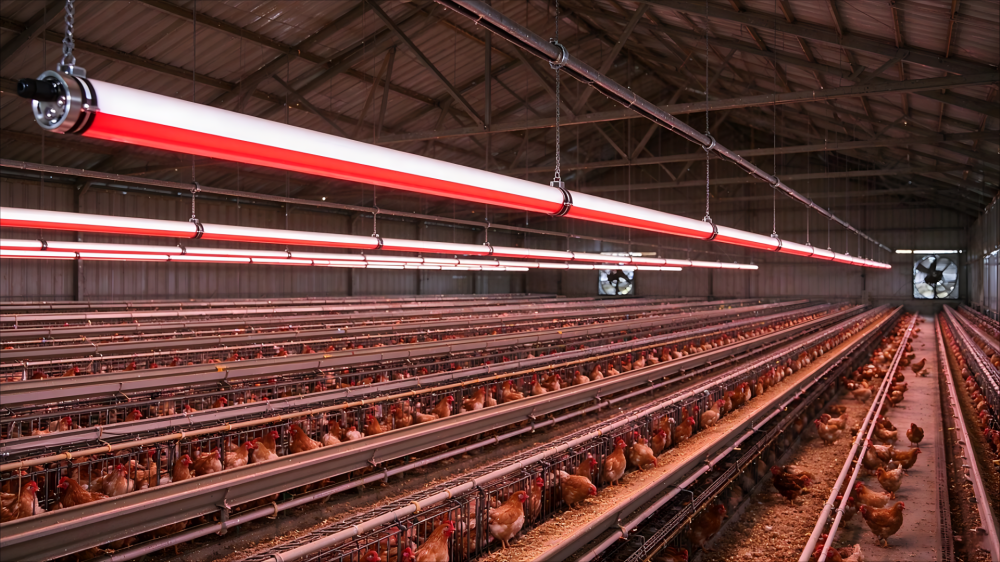
Laying hens (layers): Red-rich spectrum helps regulate sexual maturity, stabilise egg production, reduce aggression and feather pecking. White light provides clear visibility for feeding, inspection and farm management. Red and white dual-spectrum lights are widely adopted for layer houses to balance production and welfare.
Broilers: A calm lighting environment lowers stress and fighting, improving feed conversion ratio. Red-white dual spectrum works well for broiler barns when paired with smooth dimming.
Breeders: Require stricter, programmable lighting rhythm. Flicker-free adjustable spectrum and brightness are essential for fertility control.
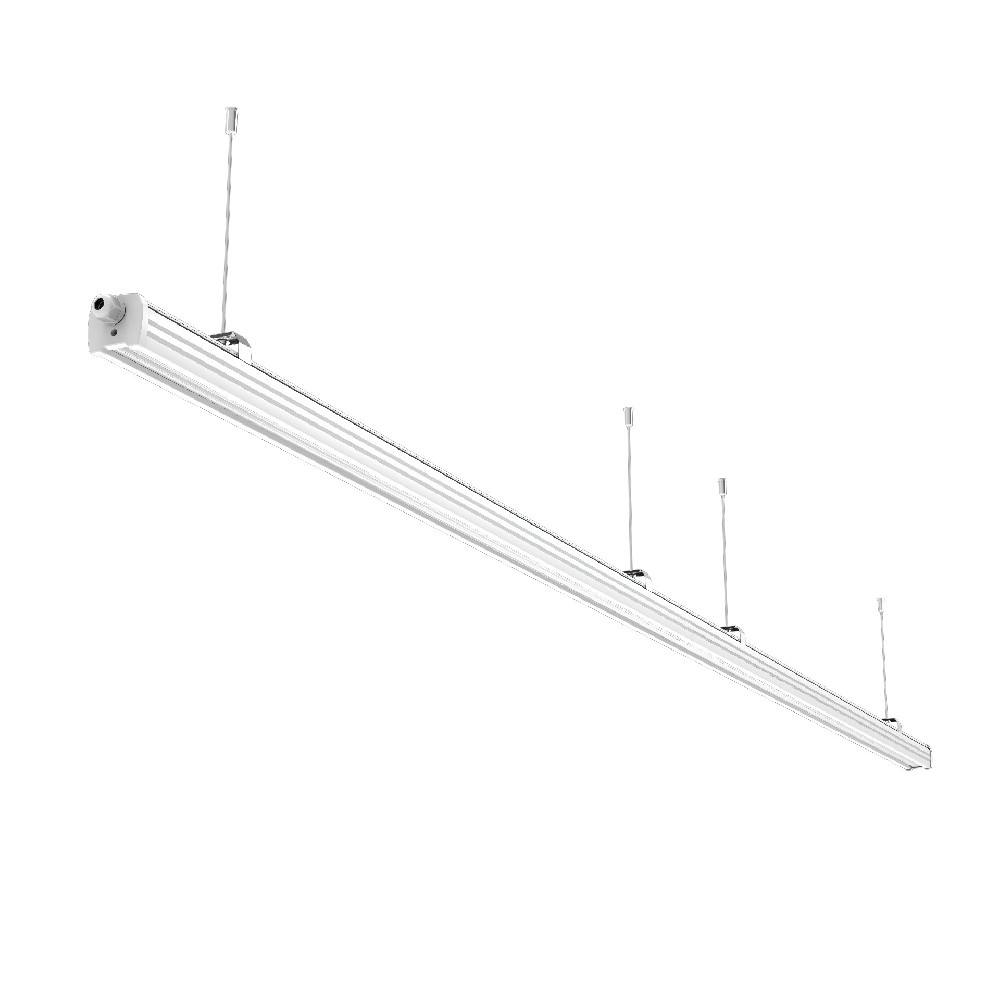
Standard single-spectrum white lights cannot deliver these targeted benefits. Our 75mm round tube IP69K poultry LED light adopts red & white dual spectrum, specially tuned for poultry physiological needs instead of human lighting requirements.
2. Select the correct IP protection grade for your cleaning routine
Poultry barns are high-corrosion environments filled with ammonia, dust and regular hot high-pressure washdown and disinfection. Ordinary IP65 or IP67 fixtures may survive light splashing but will fail quickly under frequent jet cleaning.
For dry barns without regular high-pressure washing: IP65 is the minimum baseline.
For commercial barns that wash between flocks with high-pressure hot water and disinfectant: IP69K is the ideal choice. It is tested to withstand close-range high-temperature, high-pressure water jets from multiple angles, and the fully sealed structure blocks ammonia gas and dust ingress.
Not all IP69K lights are the same. Housing material matters. Anti-corrosion PC or PMMA tubing is required to resist ammonia and chemical cleaners, preventing yellowing, cracking and internal circuit damage. Our 75mm round tubular IP69K fixture is built with ammonia-resistant housing, designed for repeated washdown cycles without removing the lights before cleaning.
3. Check dimming mode and flicker-free performance
Smooth sunrise-sunset dimming is one of the biggest differences between farm-specific lights and general LED lights. Sudden on/off or sharp brightness changes will panic chickens, cause piling and stress response.
0-10V analogue dimming is the most common and reliable solution for large poultry farms. It supports continuous brightness adjustment from 0–100% and works with most mainstream poultry lighting controllers.
Avoid low-cost PWM dimming products that produce invisible flicker. Flicker disturbs birds’ nervous systems, increases pecking risk and hurts long-term production performance.
When you choose 0-10V dimmable poultry lights, confirm the output is flicker-free across the whole dimming range. Our 75mm round tube IP69K poultry light supports smooth 0-10V dimming, suitable for programmable lighting schedules for broiler, layer and breeder houses.
4. Light distribution, fixture shape and installation layout
For open poultry barns, uniform light distribution at bird level is critical. Dark corners or over-bright zones will cause uneven feeding and inconsistent growth.
Round tubular tri-proof lights deliver wide, even light spread, easier to install in rows along the barn than small spot lights.
The 75mm diameter round tube design is popular in modern poultry houses, with simple suspension brackets and integrated wiring, saving installation time.
Before bulk purchase, calculate required lux level according to flock age: chicks need higher lux, while mature layers and finishing broilers run under lower, stable brightness.
5. Certification, lifespan and after-sales support
Do not ignore compliance and reliability. Look for CE, RoHS and relevant agricultural lighting certifications. Ask suppliers for photometric reports, IP69K test certificates and ammonia resistance data. A professional poultry light should maintain stable light output over years, instead of rapid lumen depreciation. Compare warranty terms and spare parts supply, especially for large-scale farms with hundreds of fixtures.
Final Tip: Match the whole lighting system, not individual lights
The best practice is to treat poultry lighting as a complete system: spectrum + IP rating + dimming control + layout design. Even high-quality fixtures will underperform if the controller, wiring or lighting schedule is mismatched.
For commercial farms that carry out regular high-pressure washdown and want to reduce feather pecking, improve egg production or FCR, flicker-free, red-white dual spectrum, 0-10V dimmable IP69K tubular LED lights are a mature, proven solution.
If you are looking for a ready-to-use solution, our 75mm round tube IP69K poultry LED light combines all above features, ready for layer, broiler and breeder chicken houses.